A proper review of the measurements of methane emissions and carbon sinks would open up new opportunities for the country and its livestock industry.
The title might sound obvious to a public convinced that beef production emits an excess of greenhouse gases that exacerbates global warming. But the obviousness is not so great if the issue is viewed from a more novel perspective.
¿Cumplen los países los compromisos que firmaron a partir de la COP 21 de París, en 2015, para detener el calentamiento global? La respuesta es sencilla; algunos sí; otros no. Aunque las emisiones globales aumentan a tasas menores, la temperatura media del planeta ya rebasa los umbrales que acordaron no transgredir. Mientras tanto, muchos países informan la evolución de sus emisiones a través de Inventarios Nacionales (INGEI), Informes Bienales de Transparencia (IBT) y Contribuciones Nacionales Determinadas (CND).
Argentina's latest official estimate indicates that the country emitted 401 million tons of carbon dioxide equivalent (t CO2 eq) in one year. It's worth noting that this figure represents less than 1% of global emissions. Agriculture accounts for 38% of these emissions, with 20% coming from cattle ranching. Regarding its commitments, Argentina pledged that its net emissions by 2030 would not exceed 359 million t CO2 eq. At the recent COP30 in Brazil, it raised this figure to 375 million t CO2 eq for the period 2030-2035, which generated considerable criticism.
The carbon emission and sequestration figures reported by countries are derived from calculation methods that fall into a gray area subject to scientific review. Most developing countries calculate their inventories based on standards originally calibrated for temperate, humid climates in the Northern Hemisphere. Although adjustment algorithms exist, these models do not always accurately reflect the realities of other environments.
Gray area
From a practical standpoint, the existence of gray areas allows us to investigate and rethink impacts. The impact of cattle production is one of them. For example, recent research suggests re-analyzing two important impacts: methane emissions from cattle and carbon sequestration in pasture-based livestock systems.
That cattle emit methane, and that methane has a high global warming potential, is nothing new. But methane falls into a gray area when its impact is reanalyzed over time. Today we have two calculation options (A and B) that produce conflicting results. The conventional Path A, used to compile official inventories, assumes that methane accumulates in the atmosphere over a prolonged period and therefore has a persistence similar to that of the dominant gas, carbon dioxide. However, recent research warns that methane is a short-lived gas that decays in 10-12 years, and that in the long term it has a much smaller impact than estimated by Path A. As an alternative, Path B emerges, which reinterprets its warming potential over the long term (100 years). If Path A estimates that bovine methane contributes about 80 million tons of CO2 eq per year as emissions for Argentina, Path B would reduce that figure to 8 million due to the short life of methane in the atmosphere, which would result in an avoided emission of about 72 million tons of CO2 eq per year.
The other gray area involves carbon sinks that capture carbon (C). The conventional metric estimates long-term changes (on average, 20 years) in soil organic carbon stocks. Only if the stock increases is it inferred that there has been stable carbon sequestration. But the method carries an unresolved asymmetry. Calculating carbon emissions in a single year, and then having to wait several years to determine whether or not carbon sequestration has occurred, leads to practical complications in estimating the balance. The modern world operates at a different pace, and the carbon balance is increasingly intertwined with production, the economy, and business. If the goal is to measure annual carbon uptake, it is more efficient to estimate how much carbon accumulates in vegetation through photosynthesis over the same period in which emissions are measured. Satellite measurements facilitate these calculations; Net Primary Productivity (NPP) can serve this purpose. Although it does not reflect the complexity of carbon sequestration in soil, the NPP metric allows us to quantify the net gain of carbon in vegetation and use it to offset emissions within the same year.
Grazing areas
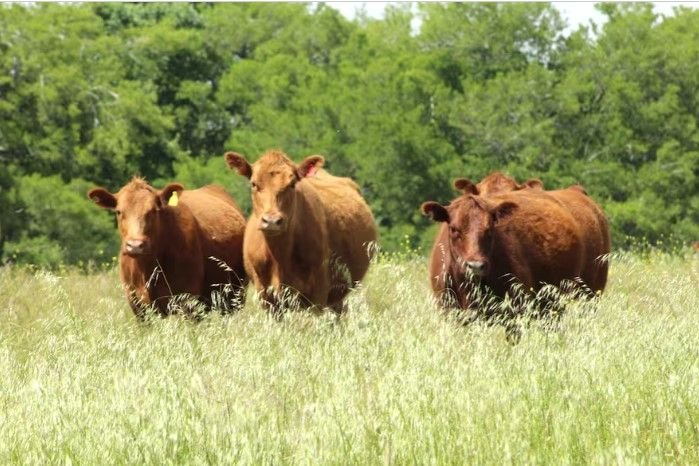
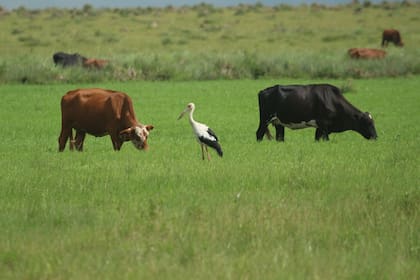
As carbon sinks, forests receive more attention than grazing lands due to their capacity to produce biomass and the ease with which that production can be measured. However, grazing areas in Argentina are much more extensive than forested areas, and include not only grasslands, pastures, and annual grazing lands, but also savannas, native forests, shrublands, etc. The FAO reports that Argentina has approximately 176 million hectares dedicated to cattle grazing. Simplifying calculations, if we assume a very modest average net pasture productivity (NPP) of just 0.5 tons of dry matter (aboveground + belowground) per hectare per year, half (0.25 tons/ha) would be carbon gain. Converted to CO2 equivalents and extrapolated to the 176 million hectares, Argentina would have an additional carbon sink of approximately 160 million tons CO2 equivalent per year.
If we add the avoided methane emissions (72 million) to this 160 million tonne carbon sink, we obtain a figure of 232 million tonnes of CO2 equivalent that could be subtracted from the 401 million tonnes of emissions estimated by our inventories. This rudimentary calculation shows that Argentina could exceed its commitment to reduce its emissions to the levels agreed upon for 2030-35 right now.
We can debate endlessly whether both methods of accounting for carbon are equally valid. Some authors propose that developing countries maintain the conventional method for preparing official reports, while simultaneously incorporating another that considers the short lifespan of methane and the carbon sequestration of their grazing systems. Focusing solely on cattle farming, this simple accounting review would open up an opportunity for the country to renegotiate its climate goals on a global scale. And on a smaller scale, it would open up an opportunity for the livestock sector to intelligently negotiate compensation (such as tax breaks, export certifications, and carbon credit issuance) for its contributions to climate change mitigation.
The author is a corresponding member of the National Academy of Agronomy and Veterinary Medicine
READ THE ARTICLE FROM La Nación