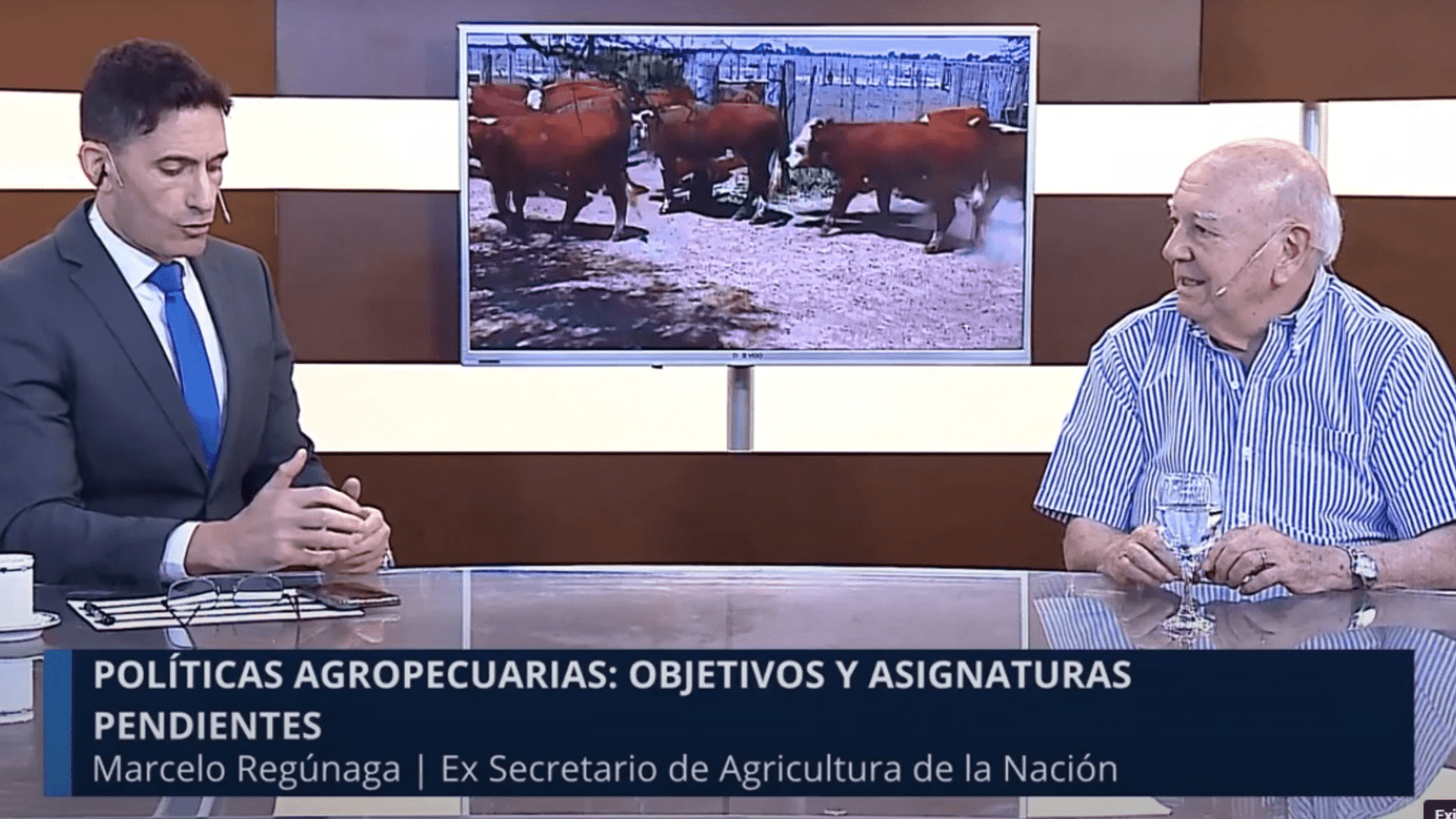
The former Secretary of Agriculture of the Nation analyzed on Canal Rural the impact of deregulation, the international scenario and the pending challenges for the agro-industrial complex, with a focus on export taxes, interest rates and infrastructure.
Marcelo Regúnaga stated that the year was "quite favorable for many agricultural activities," with a clearly positive balance for livestock and an acceptable performance for agriculture, despite an international context of tighter prices.
Regarding livestock, he emphasized that the international environment was very favorable, and Argentina had low stock levels, which strengthened domestic prices and future prospects. "The outlook for livestock activities, especially cattle, was very good and will continue to be so, because domestic prices are good and because export taxes were eliminated," he explained.
Regarding agriculture, Regúnaga noted that international prices were relatively low, although the weather compensated for this. “Except for producers affected by floods or isolated cases, very good yields were observed, which allowed for a positive year for a large part of the Pampas region,” he stated.
The former official praised the government's signals regarding deregulation and predictability. "The messages from the President and the Minister of Economy showed interest in reducing the tax burden and export duties, and that created a more favorable environment for production and exports," he stated. However, he cautioned that a long-term plan was still lacking.
"I would like a clear program for eliminating withholding taxes and greater certainty on how the tax burden will be reduced."
Looking ahead to 2026, he believes the sector will start in a better position, with less debt, although he warned about the financial costs. “Interest rates remained extremely high, and that’s a problem, especially for small producers. The cost of capital in Argentina is still very high,” he emphasized.
Regúnaga also emphasized the need to reduce the so-called “Argentine cost.” In that regard, he highlighted infrastructure as a critical issue: “Infrastructure generates extremely high costs and inefficiencies. Accelerating privatizations and resolving issues like the Paraná-Paraguay Waterway would be key to lowering costs without the State having to invest directly.”
Furthermore, he emphasized the importance of adding value and differentiating products, and acknowledged progress in the joint work between the Ministry of Foreign Affairs and the Ministry of Agriculture for market access, although he clarified that these results are not seen immediately.
Finally, when referring to subnational tax pressure, he stated that the great challenge involved a coordinated tax reform.
“It is essential to resume lowering distortionary taxes such as Gross Income Tax and to work intensively with the governors. Without that agreement, it is difficult to avoid offsetting the national government's fiscal efforts,” he concluded.
The full interview is available on Canal Rural Noticias:
READ THE ARTICLE FROM El Rural.com